Some letters are already forgiven before they are opened. The one who wrote them doesn't know it yet.
I / The letter
He saw him from far off
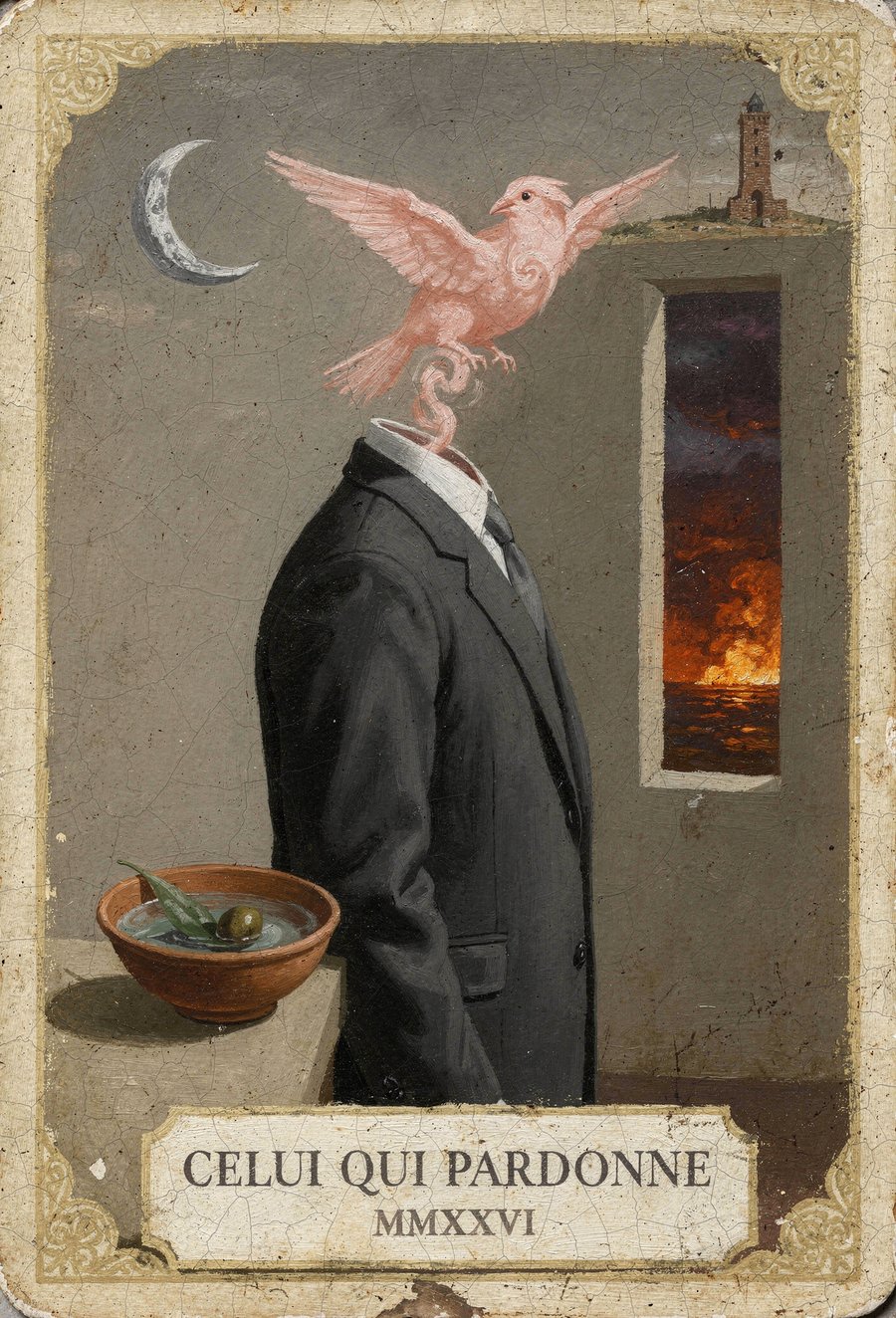
The scene is simple: a man in a suit reads a letter. It could be an apology, a confession or a request — it doesn't matter what it says. What matters is something else: this man had already decided to forgive before opening it. The one who truly forgives doesn't wait to hear the apology in order to decide; he decides beforehand.
That idea comes from one specific story — the parable of the prodigal son — and it deserves telling in full, because it is the mother scene of this card. A son asks his father for his inheritance while the father is still alive. In that world, this was almost like telling him: to me, you are already dead. The father gives it to him. The son goes far away, squanders everything, and ends up starving, herding pigs — the impure animal for a Jew: for those listening to the parable, there was no lower to fall. He decides to return, and on the way he rehearses a speech: father, I have sinned, I no longer deserve to be your son, hire me as a day labourer. And then the gospel gives the detail that changes everything: «while he was still far off, his father saw him and ran». Ran. In that culture, a patriarch never ran: running was undignified, losing face in front of the whole village. This father humbles himself first, before hearing a single word of apology. He embraces his son and doesn't let him finish the speech. The forgiveness was already decided — probably since the day the son left.
That forgiveness arriving before the apology is the subject of this card.
II / The smoke
What forgiving costs
The man has no head: in its place rises a pink smoke that, higher up, becomes a bird. It is a way of saying what truly forgiving costs: you have to let go of the head — the arguments, the story in which you were right, the exact account of the harm done to you. When you forgive, all of that stops being ammunition and becomes something light that flies away.
The French philosopher Vladimir Jankélévitch said it bluntly: if you only forgive what has an excuse, that is not forgiveness — it is accounting. Real forgiveness forgives what has no excuse.
And Hannah Arendt — a German Jewish philosopher who had to flee Nazism, and who spent her life thinking about how one keeps living after harm — explained why we need forgiveness: because what is done cannot be undone. Nothing we do can be taken back; that is the human condition. Forgiveness is the only thing that resembles an undo: it doesn't erase the harm, but it loosens the knot that ties both people to that moment — the one who did it and the one who suffered it — and lets them both begin again. Without forgiveness, Arendt says, we would remain prisoners forever of a single act of our past.
That is why, on the card, the window burns while he reads calmly: the harm was real, and he has decided all the same.
III / The bowl
Peace starts small
On the floor there is a clay bowl with water and a single olive leaf. Not a whole olive tree: one leaf. Peace doesn't arrive all at once or complete: it arrives in small, domestic signs, almost ridiculous compared with the burning sky in the window. At the back, a tower keeps watch: it is pride, which always looks for a high place from which to go on being right.
Forgiving is not forgetting, and it is not giving up on justice. Pope Francis summed it up in Fratelli Tutti: what forgiveness gives up is not justice — it is revenge. It is refusing to let the harm decide how the story ends.
You carry this card on you to remember one thing only: forgiveness is decided beforehand.
// Sources
- Luke 15:11–32. The parable of the father who runs.
- Hannah Arendt. The Human Condition. 1958.
- Vladimir Jankélévitch. Le Pardon. 1967.
- Pope Francis. Fratelli Tutti. Encyclical, 2020.
Forgiveness doesn't wait for the apology. It arrives first.
// The deck — Dialogues between times
Each file is an arcanum. The deck is completed card by card, one story at a time.