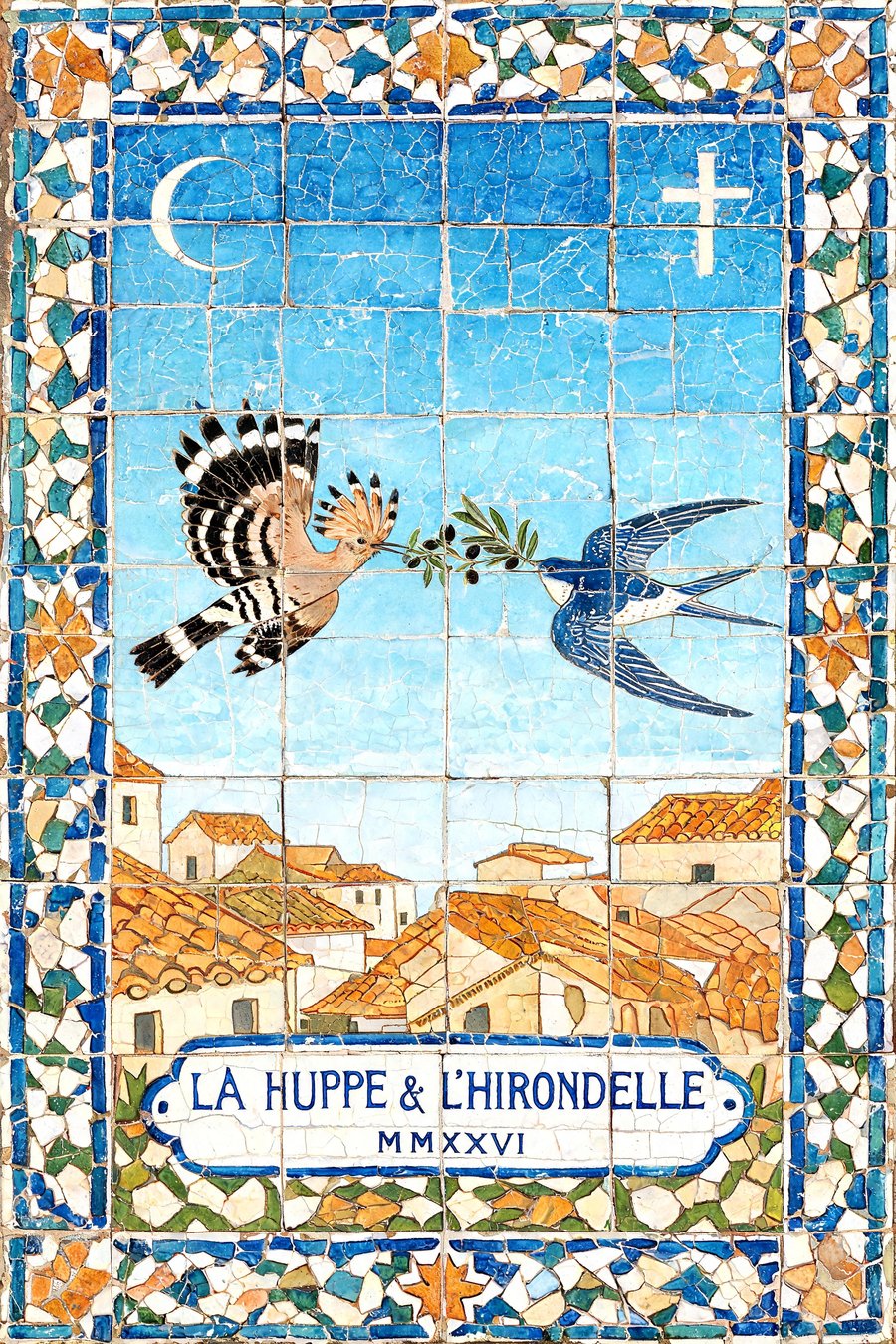
A hoopoe that prays facing her homeland. A swallow that prays by returning to its nest. The same sky is enough for them both.
I / The hoopoe
The one who orients herself
To understand the hoopoe you need to know one single thing about Islam, and it is among its most beautiful. Muslims pray five times a day always facing the same point: Mecca — and within Mecca, the Kaaba, a cube-shaped building draped in black cloth, the most sacred place of that faith. It doesn't matter where on the planet you are: every mosque in the world has a niche in its wall marking that direction, and whoever prays at home works it out before starting. Five times a day, millions of people turn at once, like compass needles, toward the same place most of them will never see. That direction has a name: the qibla.
In The Conference of the Birds — a Persian poem from the twelfth century, written by Attar — the hoopoe is the guide: she gathers all the birds and leads them through seven valleys toward what they seek. Thirty birds reach the end, looking for their god, the Simorgh, and the poem closes with a play on words that is its whole teaching: in Persian, si morgh means «thirty birds». What they were looking for outside was their own name: together, they were the very thing they pursued.
The hoopoe of this studio inherits both: the role of guide and the faith that works by orientation. Like someone praying toward a sacred place they cannot see, she recalculates every day in which direction lies what she loves. Her song — oop, oop — is a beloved name repeated over and over, like a heartbeat. That is why, when she stands still, she is not stopped: she is pointing home. Her home is her qibla.
II / The swallow
The one who returns
The swallow comes from the other shore of the Mediterranean and from the other tradition: the Christian one. It nests against churches and bell towers — it lives, literally, against the wall of the sacred. In Spain there is even a folk legend that writes it into the gospel: they say it was swallows that pulled out, one by one, the thorns from the crown of the crucified Christ.
Its calendar is that faith's calendar. The swallow's god is a god who dies and rises again: Jesus, executed on a Friday and — so Christians believe — risen on the third day. Every spring, at Easter, that death and that return are celebrated anew. And every spring, punctual as Easter, the swallow returns: it leaves when everything dies in autumn and comes back when everything revives. Its migration is its tradition's faith told by a bird: going impossibly far and always returning to the same eave. Returning is its way of praying. Volverán las oscuras golondrinas — the dark swallows will return —, wrote Bécquer: he was describing a faith.
And there is a second idea of its tradition without which its character cannot be understood. In Christianity, the most important thing you receive is not earned: it is given to you. The word for that is grace. It doesn't work like a wage — behave and you will be paid — but like a gift that arrives before it is deserved. Saint Paul wrote it almost in those words: by grace you have been saved; not by works. And the gospels insist with stories: the father who runs to embrace the son who abandoned him, before he can finish asking forgiveness — the very scene of card II of this deck —; or the workers of the eleventh hour, paid the same wage as those who worked the whole day. The gift is not calculated. It is given.
The one who returns lives this without knowing it: he does nothing to make spring come back. It is given to him every year. That is why his character is what it is: he forgives easily, because he knows himself forgiven first; and he knows how to wait, because the gift arrives on its own, in its own time.
III / The olive branch between them
The sky is not divided
On the card, the two birds hold an olive branch together, between the crescent moon on one side and the cross on the other.
Ibn Arabi — a Muslim mystic born in Murcia in 1165, one of the summits of Sufism, the current of Islam that seeks God along the path of love — wrote it eight centuries ago: «my heart is capable of every form: a cloister for monks, a temple, the Kaaba… I follow the religion of Love whichever way it goes». Look at his list: the Kaaba — the same black cube the hoopoe turns toward — set beside the cloister and the temple, as equally worthy forms of the same thing. That is: love fits in every form of faith.
Fatema Mernissi called hudud the sacred frontiers: the invisible lines every tradition draws in order to separate — the pure from the impure, the inside from the outside, the us from the them. Her whole work asks who draws those lines and who pays their price. These two birds don't erase their frontier: they cross it and come back. The two traditions speak of the same thirst with two different verbs: to orient oneself (her) and to return (him). And they teach each other: she learns from him that what is loved also comes back; he learns from her that home can be prayed to from afar.
To love each other, for these two, is to cross the frontier of one's own tradition without ceasing to belong to it — out of loyalty, not flight.
// Sources
- Farid ud-Din Attar. The Conference of the Birds. 12th century.
- Ibn Arabi. The Interpreter of Desires. 13th century.
- Ephesians 2:8 · Luke 15 · Matthew 20. Grace and its parables.
- Fatema Mernissi. On the hudud, the sacred frontier.
- Gustavo Adolfo Bécquer. Rimas. 1871.
Two ways of praying. The same sky.
// The deck — Dialogues between times
Each file is an arcanum. The deck is completed card by card, one story at a time.