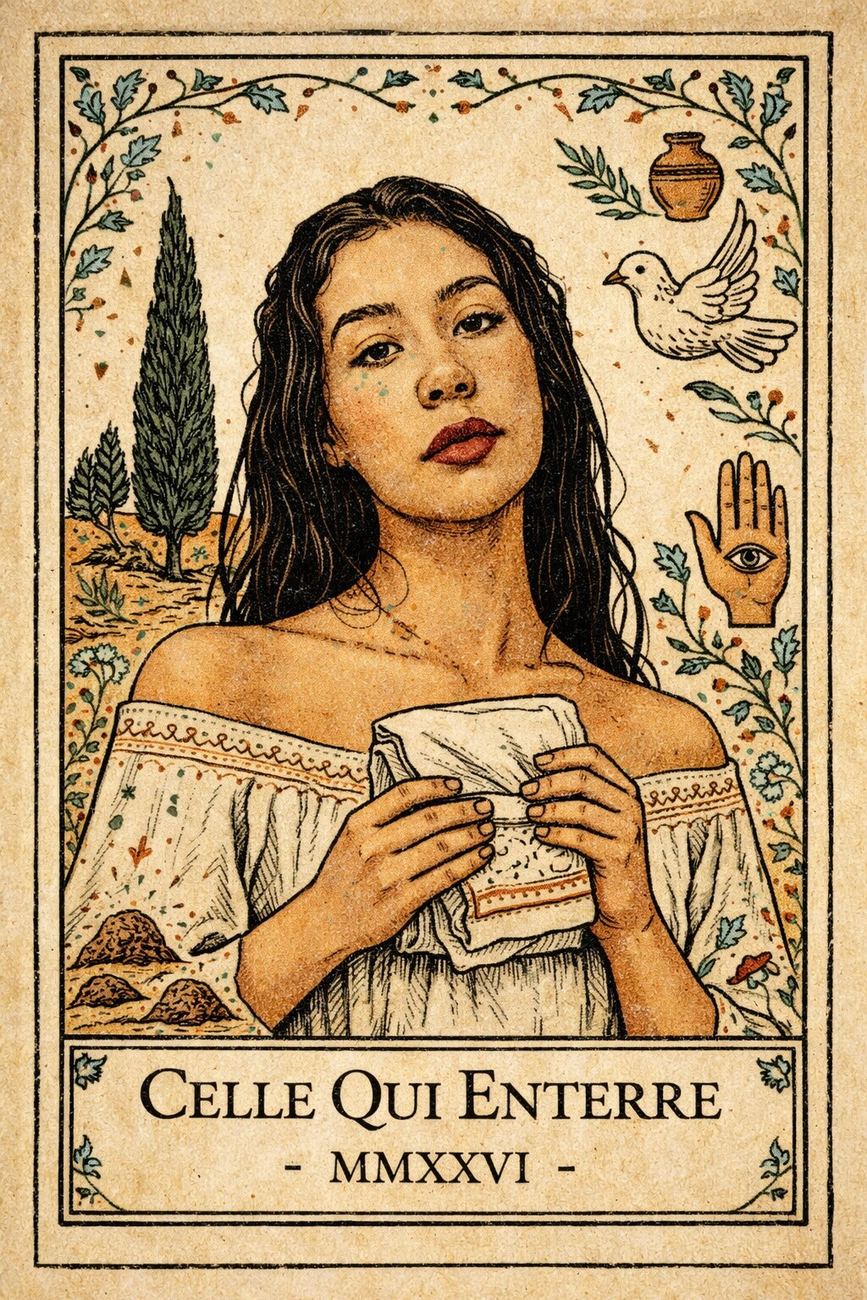
Some hold up a house that should have collapsed already, and no one understands why it hasn't fallen. It's because of her. The tarot card knows.
I / The story
A woman buries her brother
Antigone is a Greek tragedy: Sophocles wrote it in Athens almost twenty-five centuries ago. The story fits in one paragraph, and it needs telling, because everything that follows rests on it.
Thebes is coming out of a civil war. Oedipus's two sons have killed each other fighting over the throne. Creon, the new king, decides one was a hero and the other a traitor, and passes a law: for Eteocles, a funeral with honours; for Polynices, no grave — his body stays outside the walls, for the vultures, and whoever tries to bury him will be executed. For the Greeks there was no worse punishment: an unburied dead man would never rest. Antigone, sister to both, goes out at night and covers Polynices's body with her own hands. She is caught. Creon condemns her to be walled up alive in a cave. She doesn't take it back: the laws of the gods, she tells him, were not written by you.
Ever since, every age has read this story the way it needed to. The most repeated reading turns her into the heroine of conscience: the woman who disobeys an unjust law out of loyalty to something higher than the law. She is the Antigone quoted in courtrooms and at demonstrations, the mother of all civil disobedience. That reading is true. But it leaves out exactly what this card wants to look at.
II / The stance
She stays. That is the piece.
It helps to measure the size of the ruin Antigone is standing on. Her father, Oedipus, died blind and banished, after discovering that the woman he had married was his own mother. Her mother, Jocasta, hanged herself when she learned it. Her two brothers have just killed each other. And her sister Ismene, the only one left, tells her from the very first scene: I can't, I'm too weak, you go.
Antigone stays alone. She stays. That is the piece, not the burial. The burial is a gesture that lasts one night; staying is a stance that lasts a life. A young woman, alone, in a house destroyed from every direction, deciding not to leave.
María Zambrano — a Spanish philosopher; she lost her own civil war in 1939 and wrote most of her work banished from Spain, so she knew what a house that no longer exists is — devoted an entire book to her, La tumba de Antígona, written in exile. From her reading, this card takes its central idea: Antigone doesn't act out of heroism. She acts because staying is the only position still free once everyone else has gone. Fidelity is not a feat: it is what happens when the others have withdrawn.
III / A thousand kitchens in Belleville
It's just what you do
In the twentieth arrondissement of Paris, in Saint-Denis, in the north of Marseille, in Roubaix, in Schaerbeek in Brussels — in any European city with a Maghrebi diaspora, families come from Morocco, from Algeria, from Tunisia — there are thousands of daughters doing exactly this. They carry a mother who demands to be treated like a queen without a kingdom left. They carry a father who has withdrawn into silence or pain — the back, the soul, the exile. They carry a younger sister they don't want to leave alone. And when someone asks them why, they answer: «it's just what you do». Antigone's line, translated into a twenty-first-century kitchen.
Why does it fall to them? Fatema Mernissi — a Moroccan sociologist, raised in a domestic harem in Fez (a traditional household where the women lived secluded, the street off limits) and one of the first to study with modern tools how power is shared inside the Muslim family — described in Beyond the Veil the arrangement everything rests on. In the traditional family model, each parent holds up one half of the house: the father represents it to the outside, the mother governs it from within. That arrangement of duties and hierarchies has a name: the patriarchal bargain. From Mernissi's work you understand what happens when one of the two fails — leaves, falls ill, gives up: the system doesn't share that weight among all its members. The weight falls whole, one step down, and it falls almost always on a daughter. Not on a son: sons are raised to leave; daughters, to hold. The eldest daughter becomes her siblings' substitute mother and her parents' nurse without anyone deciding it out loud, with no wage and no end date. She doesn't inherit freedom. She inherits weight.
Asma Lamrabet — a Moroccan doctor, a practising believer — belongs to something many people don't even know exists: the feminist theology of Islam. They are believing women — doctors, jurists, professors — who read the Quran for themselves and separate what the text says from what its interpreters — almost all of them men — said about it for centuries. They don't attack their religion from the outside: they reclaim it from within. Lamrabet argues that this theology cannot stay forever on the question of the veil: it has to examine the real domestic contract that keeps daughters bound to families that don't hold them up. Mernissi and Lamrabet agree on the diagnosis: change won't come from a law. It will come the day a daughter decides that fidelity and servitude are not synonyms.
IV / The card
The keeper of the weight
The figure you see belongs to the language of the tarot. An arcanum — Latin for secret — is each of the deck's major cards: Justice, Temperance, the Hermit. The tarot has centuries of popular use behind it and always works the same way: each arcanum condenses one moral operation into a single figure. Ours is Celle Qui Enterre, the keeper of the weight. Not the victim. Not the heroine. The one who stayed.
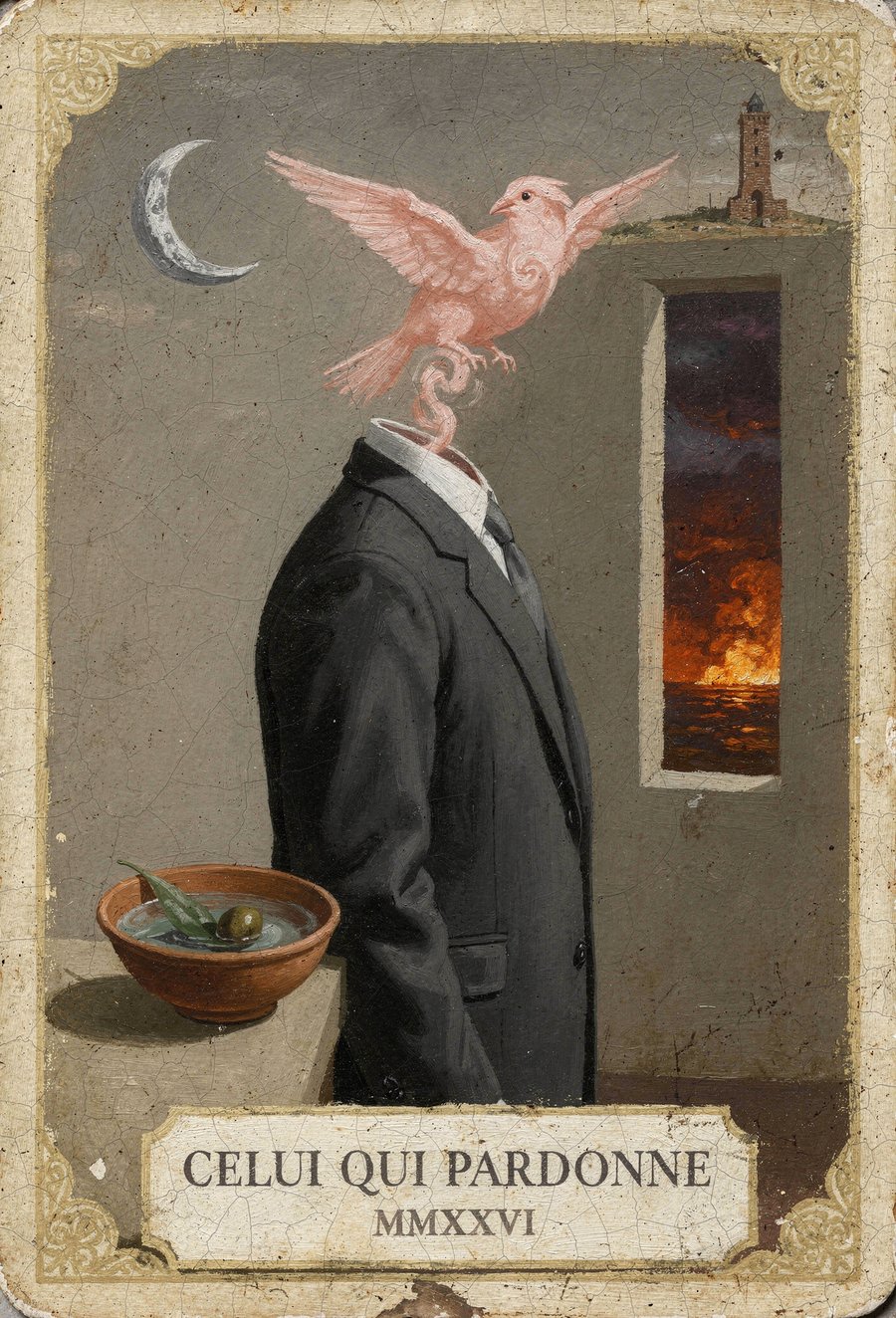
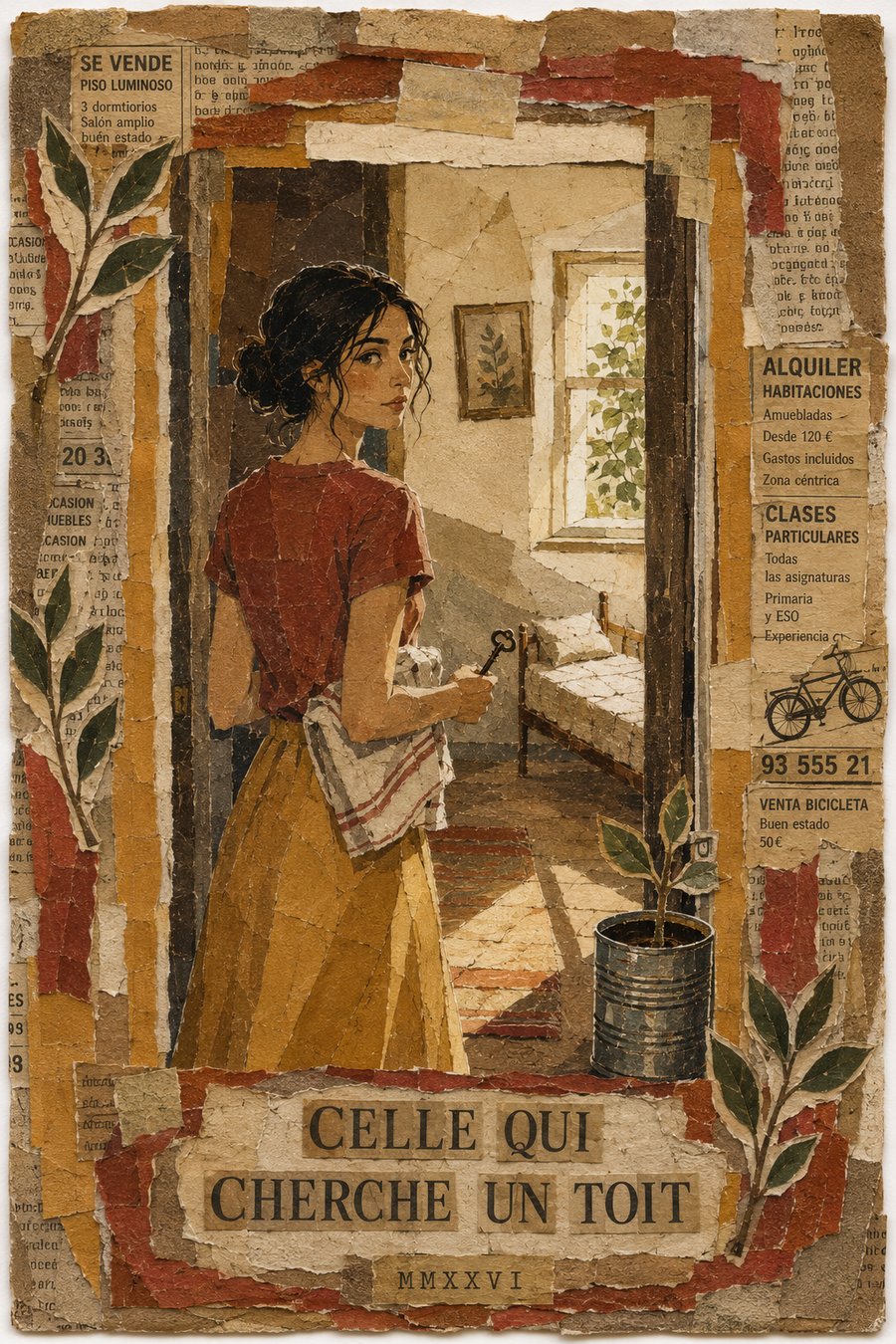
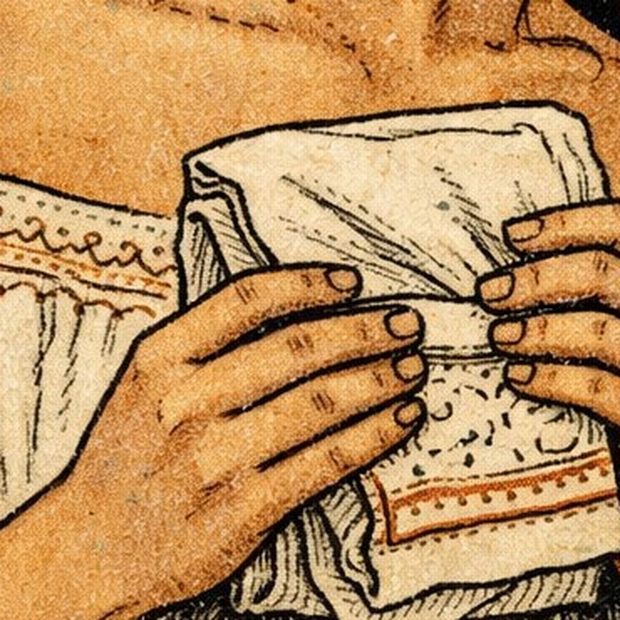
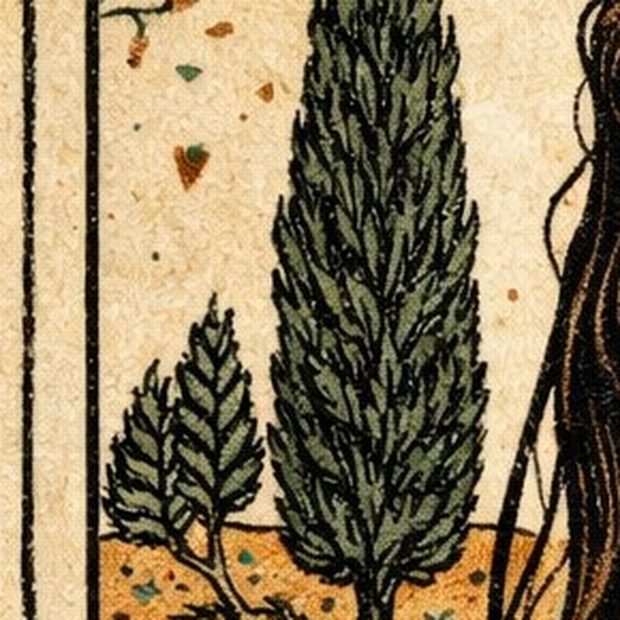
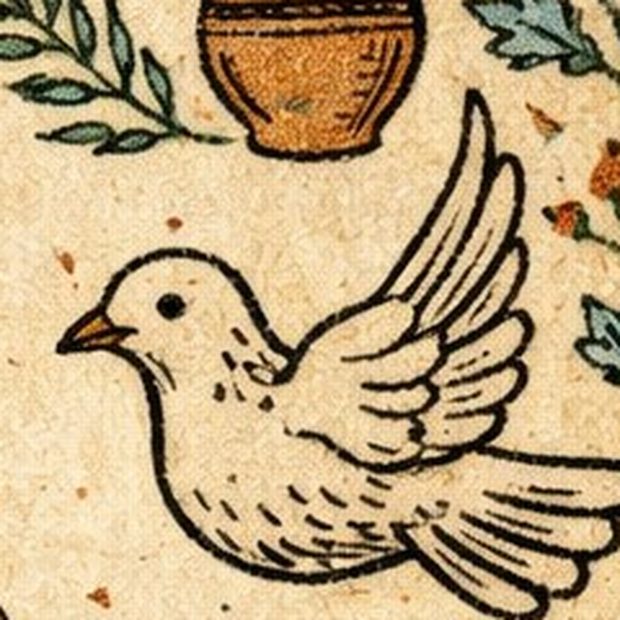
She holds a folded cloth: a fabric, a frontier, what separates what is falling from what still stands. On one side, a cypress — the tree the Mediterranean has planted beside its cemeteries for millennia: it marks where the dead rest. On the other, a vessel with an olive branch, which comes from a specific story: in the biblical account of the flood, Noah releases a dove from the ark and the dove comes back with an olive leaf in its beak — the sign that the water is receding and the world is becoming liveable again. Ever since, the olive has meant exactly that: peace, but still as a promise. That is why the dove on the card hovers and doesn't land: it is what will rise when there is nothing left to carry.
The card is in French because French is the language of the modern tarot — and because the daughters this card portrays mostly think in French when they tell themselves, silently, what they are feeling.
V / The flat she looks for
Letting herself be loved too
The piece doesn't end in the weight. It ends in an almost invisible decision: looking for a flat of her own. A place where she can sleep next to someone who loves her well. The daughter who carries doesn't abandon — she keeps coming back to her mother's kitchen — but she stops being only the one who carries. She begins to be, in parallel, the one who lets herself be loved.
Translated back into Sophocles, that wasn't in the play: Antigone dies before she can be loved. The card rewrites her: Celle Qui Enterre is still alive. What she buries now is not her brother — it is the idea, inherited from the patriarchal bargain, that a daughter's fidelity demands her own erasure.
The Christian love this studio stands for understands the operation. When Jesus was asked which commandment was the greatest, he answered with two that are one: love God, and love your neighbour as yourself. Everything is in that as yourself: without it, love of neighbour stops being love and becomes servitude. The daughter looking for a flat doesn't betray her family. She is finally fulfilling the second half of the commandment.
// Sources
- Sophocles. Antigone. Athens, 5th c. BC.
- María Zambrano. La tumba de Antígona. 1967; Mondadori ed., 1989.
- Fatema Mernissi. Beyond the Veil. Schenkman, 1975.
- Asma Lamrabet. Femmes et hommes dans le Coran : quelle égalité? Albouraq, 2012.
- Matthew 22:36–40. The double commandment.
// Further reading
- Judith Butler. Antigone's Claim. 2000.
- Pope Francis. Fratelli Tutti. Encyclical, 2020.
The card is for whoever needs it. Without guilt. Cover what you hold. And make space, too, for what holds you.
// The deck — Dialogues between times
Each file is an arcanum. The deck is completed card by card, one story at a time.