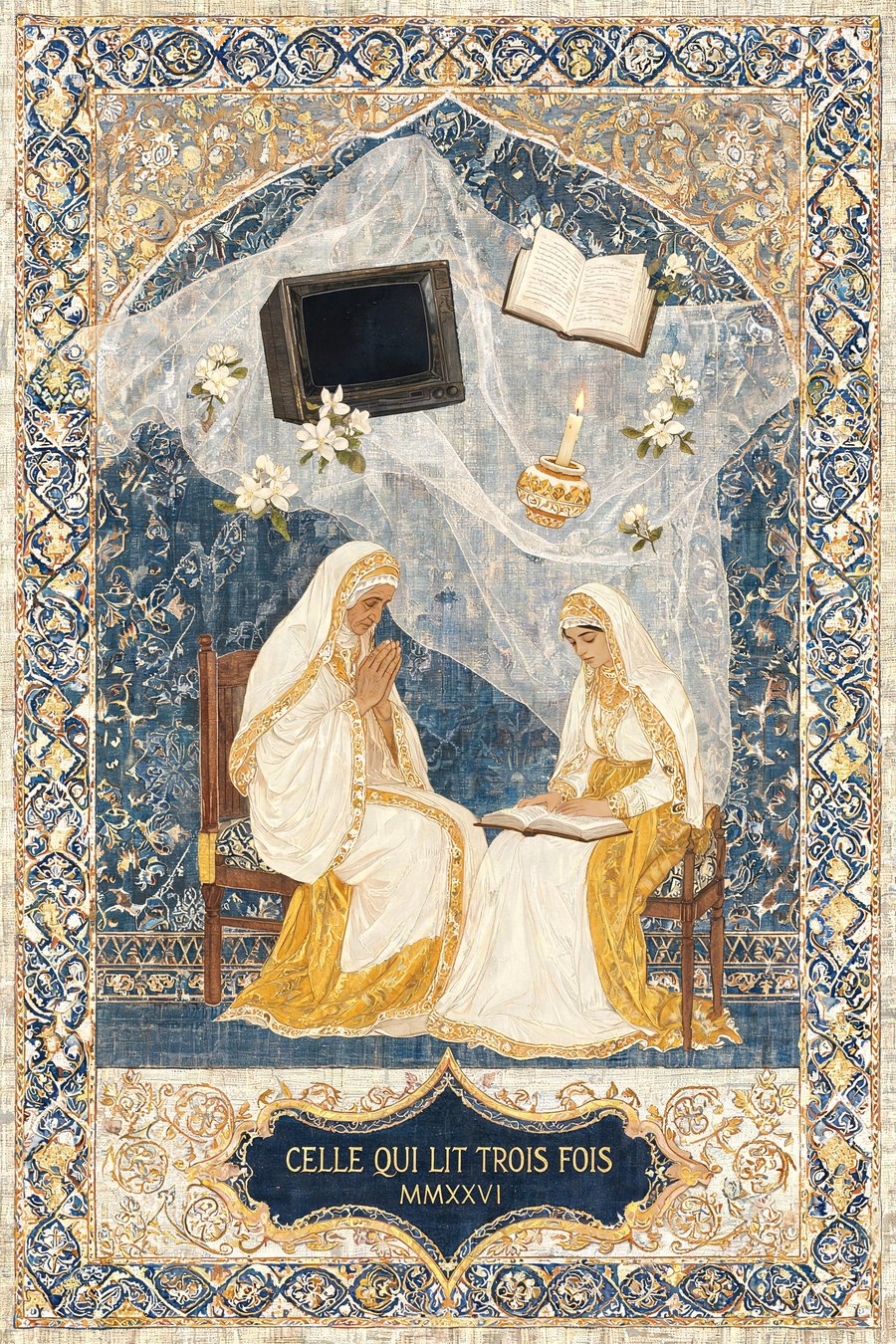
A veil is never one single thing. It is at least three, depending on who is looking.
I / First reading
The grandmother who prays
The first way to understand the veil is not in any book: it is a grandmother praying with it on. She wears it the way inherited things are worn — out of habit, out of memory, without a discourse. Nobody imposed it on her this morning; she has worn it all her life, as part of who she is.
This first reading deserves respect, exactly as the other two deserve criticism. If the private faith of that grandmother is not respected, the criticisms that come after lose their legitimacy. Personal faith is not the enemy. It never was.
II / Second reading
Mernissi reads the history
The second reading was made by Fatema Mernissi (Fez 1940 – 2015), a Moroccan sociologist. She grew up inside a domestic harem — a traditional house where the women lived secluded, the street off limits — and became one of the most influential thinkers of the Muslim world. She did what almost nobody had done: go back to the texts and the history to ask where the obligation to cover actually comes from.
What she found — together with what the historian Leila Ahmed documented — can be told as a story in three acts. First (Mernissi, Le harem politique): the verse of the veil comes down in Medina at a very specific moment — the Prophet's house opened onto the street, the city was at war, and his wives were harassed when they went out. The verse creates a protection for a context. Second (Ahmed): the generalised seclusion of women comes later, when the Muslim empires — the Umayyads and the Abbasids, the dynasties that ruled Islam's first centuries — copy the customs of the courts they conquer: in Byzantium and in Persia, veiling and secluding women had been a mark of elite rank for centuries. Covering spread the way the fashions of power spread: from the top down. Third: centuries later, the jurists turn that custom into religious law. Mernissi's conclusion: the obligation to cover women grew with political power, not with revelation. And with that the question changes: it is no longer «what are you wearing?», but «who decided it for you?».
Asma Lamrabet — a Moroccan doctor, a practising believer — follows that path from inside the faith, and her whole operation fits in one sentence: separate the text from its interpreters. The Quran was interpreted between the eighth and tenth centuries by jurists — men, all of them — and their rulings were handed down generation after generation glued to the text, until they were treated with the same reverence as the revelation itself. Lamrabet goes back to the text without that layer on top and finds that much of what is presented as divine command is, in fact, medieval opinion. The two women say the same thing in different words: the oppression does not come from the sacred text; it comes from those who administer it. Criticising that from inside one's own religion is not betraying it: it is loving it with open eyes.
III / Third reading
The switched-off screen
The third reading happens far away, on a television: the veil turned into spectacle. It is talked about endlessly, and the women who wear it are barely listened to; everyone projects their own fears onto it.
The historian Joan W. Scott proved it with a concrete case. In 2004, France banned the veil in state schools by law. Scott studied the entire debate — parliament, press, talk shows — and found that it talked about the Republic, about laïcité, about France's colonial past in Algeria, about the fear of immigration. About everything except the actual schoolgirls, whom almost nobody asked anything. Many wore the headscarf by their own decision, and were expelled from class in the name of their own liberation. Her conclusion: a veil ban says more about who bans than about who covers.
That is why the television on the card is switched off. Not to silence the subject: to be able to hear the other two readings — the grandmother's and Mernissi's — without the noise from outside. Switching off the TV is the first gesture of respect, and also the condition for criticising seriously.
The three readings together lead to a single conclusion: a chosen veil and an imposed veil are not the same thing, even if the cloth is the same. Defending the grandmother who prays and defending the woman who decides to take it off is one and the same position: being against imposition — whether it comes from the regime that forces it on (Iran has imposed it since the 1979 revolution; the Taliban impose it today in Afghanistan) or from the prejudice that forces it off.
// Sources
- Fatema Mernissi. Le harem politique. 1987.
- Leila Ahmed. Women and Gender in Islam. 1992.
- Asma Lamrabet. Femmes et hommes dans le Coran : quelle égalité? 2012.
- Joan Wallach Scott. The Politics of the Veil. 2007.
// Further reading
- Fatema Mernissi. Beyond the Veil. 1975.
Covering yourself silences no one. Forcing someone does.
// The deck — Dialogues between times
Each file is an arcanum. The deck is completed card by card, one story at a time.